Archive for the ‘Health Articles’ Category
Welcome to Chiropractic Life and Wellness Center's Health Articles Archive. Here you can learn more about Chiropractic Life and Wellness Center, Chiropractic, and Dr. Brandon Chorney, today's choice for Chiropractors in New Fairfield, CT. Read Dr. Brandon Chorney's Chiropractic Health Articles for the health of it.
We look forward to serving you! Call - 203-746-6543.
by Dr. Brandon Chorney | Jul 13, 2021 | Health Articles

A year later and our Facebook homepage posts are still filled with heartache by friends and family who are experiencing illnesses and life changing disabilities due to chronic disease. Our instantaneous world connection delivers not only the triumphs but the shares of how chronic disease has now touched more of our lives worldwide than ever...
Read More >>
by Dr. Brandon Chorney | Jul 6, 2021 | Health Articles
We all love summer vacations filled with the fun of amusement parks and long days on the beach. At least, we use too. As children, we could not wait to get on the newest and fastest roller coasters and be thrown around on the lake on water skis and tubes. But as we have become...
Read More >>
by Dr. Brandon Chorney | May 27, 2021 | Health Articles
Man's trajectory from the beginning has been to come, become, adapt, and grow. Our evolution from even a small infant can be measured by lying to sitting, sitting to crawling, and finally crawling to standing. With this said our species from an outside observer would now be entered as the era of de-evolution of man....
Read More >>
by Dr. Brandon Chorney | May 20, 2021 | Health Articles
The sweet smell of warm weather is in the air! Thank Goodness! As for most of the US, this spring/summer season is a long awaited welcome to what could only be classified as a very long winter. This year as you are unpacking your summer clothes to enjoy the fresh air do not fret that your...
Read More >>
by Dr. Brandon Chorney | May 13, 2021 | Health Articles
Let’s live healthier and more active longer. That alone has become the motto of our generations who may have reached our embracing years of our thirties and older. Our ability to want to play full out is fabulous as long as we maintain and take care our health and our bodies along the way. One such joint that has an extreme amount of wear and tear and can put us on the sideline quickly is our knee joints. Remember even old injuries to our knees that may have happened when we were in our twenties can come back to haunt us in our retirement years.
At the moment there is no time machine that can transport us back in time to avoid the injury, but there are some things we can do to help keep our knees from being prone to injury and keep us kicking strong for years to come.
Start Strong Knee Tips
1. Wear Proper Shoes – If your feet tend to roll to the inside or outside, or if you have fallen arches, it can affect not only your knees, but your hips and back. A proper assessment will determine if orthotics may be a suitable option for you. Orthotics should be properly fitted and customized to your needs.
2. Exercise Intelligently – This can be a particular problem with “weekend warriors” who feel they must fit in as much exercise as possible over the weekend because they don’t have time during the week. This can contribute to an overloading of the muscles, tendons and ligaments of the knee that are not accustomed to regular exercise, leading to an injury or even micro-tears that may not show up immediately, but could over time.
3. Lose Unhealthy Pounds – Any high-impact activities are extra hard on the knees if you are overweight. If you are overweight, running and other sports that have great impact on the knees should be avoided until you have achieved a normal weight. Practice other forms of exercise in the meantime that take the pressure off the knee, such as walking, swimming, and/or cycling.
4. Increase strength and flexibility – Concentrate on stretching and strengthening the hamstrings, quadriceps, hip flexors and the vastus medialis oblique (VMO) muscles, as these provide the greatest support to the knees and ensure that the knee tracks properly. Women are especially prone to improper tracking, which places more stress on the ligaments of the knee. This misalignment creates a popping or grinding sound when you bend the knee, often accompanied by pain. Incorporate Yoga and Pilates as they are a good way to keep the muscles, tendons and ligaments of the leg and knee strong and flexible.
5. Add Safe and Natural Chiropractic Adjustments and Rehabilitation– If your spine or hips are misaligned, the stress your knees have to bear is much greater. Sacroiliac and lumbar misalignments can make one leg shorter than the other, so your gait is not straight. Studies have shown that people who had knee pain due to muscle tightness showed there was a significant improvement of the condition in all subjects after having a chiropractic adjustment to the sacroiliac joint. Regular chiropractic care can help keep excessive strain off your knees and increase range of motion.
Futurepace Your Healthcare Solution!
Our expert team would like to be part of your future healthcare solution. We will address not only the areas that are affected by pain but help restore function to help your body obtain better long lasting overall health and strength naturally.
Call Today. We are Ready to Help!
by Dr. Brandon Chorney | May 6, 2021 | Health Articles
For decades, arthritis was considered an inherent part of the aging process and a signal to a patient that it’s time to slow down. But not anymore. Surprisingly recent research points out that people much younger can develop rheumatoid arthritis pain but the best news is that people no longer need to suffer needlessly from the pain.
Recent research and clinical findings show that there is much more to life for arthritis patients than the traditional recommendation of bed rest and drug therapy.
Grasping the Meaning of Rheumatoid Arthritis
The word “arthritis” means “joint inflammation” and is often used in reference to the pain affecting a certain part of the body, for example, the neck or low back. Recent studies indicate that arthritis and arthritic pain do effect up to 80% of people over 50 years of age, but not all.
Specifically, rheumatoid arthritis causes pain, swelling, stiffness, and loss of function in the joints. Several features distinguish it from other kinds of arthritis:
- Tender, warm, and swollen joints.
- Fatigue, sometimes with fever, and a general sense of not feeling well.
- Pain and stiffness that lasts for more than 30 minutes after a long rest.
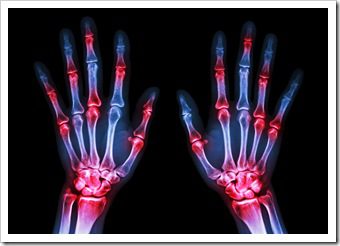
- The condition is symmetrical. If one hand is affected, the other one is, too.
- Although the wrist and finger joints closest to the hand are most frequently affected, neck, shoulder, elbow, hip, knee, ankle, and feet joints can also be affected.
- The disease can last for years and can affect other parts of the body, not only the joints.
Rheumatoid arthritis is also highly individual. Some people have mild arthritis that lasts from a few months to a few years and then goes away. Mild or moderate arthritis sufferers have periods of worsening symptoms (flares) and periods of remissions. Finally, people with severe arthritis can feel the pain most of the time. The pain could last for many years and can cause serious joint damage and disability.
Arthritis Solutions With Chiropractic Care
As spinal and musculoskeletal specialists, we look at x-rays every day. What we observe is that arthritis often develops in areas where there have been misalignments or areas where trauma has occurred and left untreated over a long period. For instance, if you suffered back or neck pain from a car accident, sporting injury, or even held an improper posture at work for a long period, over the years that area of the body can and will degenerate and your bodies protective mechanism of swelling, arthritis, in time will result.
With the traditional treatments of rheumatoid arthritis, anti-inflammatories are most frequently prescribed to patients. Unfortunately, these medications are often linked to dangerous side effects such as blurred vision, increased blood pressure, digestive ulcers and bleeding, kidney problems, dizziness and even possibly death.
Chiropractic care is a safe and natural approach that addresses the body as a whole system. This whole body approach incorporates exercise, nutrition, along with function and mobility for the best and most long lasting maintainable results.
Ready To Help!
Rheumatoid arthritis requires rehabilitation programs that cater to the specific needs and a long-term approach. Patience is required for these rehabilitation programs, and it is essential to remember that the problem has developed over a period of years and will not be fixed in a matter of weeks or months. Progress should be reached in the short-term, but such situations usually require consistent, ongoing attention to achieve the long-term solution.
Applying the appropriate rehabilitation program to this degenerative condition is essential, and chiropractic care can be of great assistance in achieving the maximum rewards from a rehabilitation program. By enabling the highest mobility of the spine and maximum function of your nervous system, regular chiropractic care’s strategic goal is to not only restore function but to revitalize the health of the entire body.
What Makes Our Team Special?
Our team specializes in techniques and treatments that address the cause of the arthritic pain directly rather than just masking the symptom of the inflammation.
Furthermore, our expert team has been uniquely formulated to bring together the right combination of knowledge, techniques, and support to help you and your family members. Not only will we help you achieve health and wellness with reducing and eliminating pain but also help future generations learn to be pro-active and avoid degenerative processes like arthritis to allow them to enjoy the activities that they desire their entire lives fully!