Posts Tagged ‘New Fairfield Neck Pain’
Welcome to Chiropractic Life and Wellness Center's New Fairfield Neck Pain Archive. Here you can learn more about Chiropractic Life and Wellness Center, Chiropractic, and Dr. Brandon Chorney, today's choice for Chiropractors in New Fairfield, CT. Read Dr. Brandon Chorney's Chiropractic New Fairfield Neck Pain for the health of it.
We look forward to serving you! Call - 203-746-6543.
by Dr. Brandon Chorney | Jun 18, 2015 | Health Articles
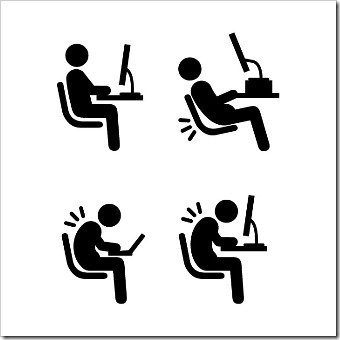
 Gone are the days of sitting back in our office chairs with our feet on the desk. Now we have gone to the absolute other extreme to where our heads are almost in the computer screen as they are stretched and extended by our form that is becoming hunched and almost disfigured. With this wonderful posture we have gained illnesses and pains that could and can be avoided. To help find and create solutions to this growing trend and to help companies have healthier employees and in turn more productivity with less sick days, the science of workplace ergonomics was developed to address work place solutions which creates a win for both employee and employer.
Simple Ergonomics
Ergonomics is the practice of suiting the conditions in which a person works to the specific capabilities and job demands of that employee. It follows that, for an ergonomic workplace to be created, a proper assessment of the environment must first of all take place so that appropriate changes can be made on the basis of accepted ergonomic principles. The aim is to create a safer and more productive working environment for the employee.
The Three Most Important Applications of Workplace Ergonomics:
- The stress of any lifting should be taken by the largest muscles to protect the smaller and more vulnerable ones.
- When working, the employee should be able to move comfortably between various correct postures so they don’t over-stress one particular part of the body for an extended period. Muscles become fatigued when kept tense for too long, especially if that one posture is poor.
- Joints should move through no more than 50% of their range when performing activities, and preferably be kept in a neutral position. Joints that are overextended can become damaged and susceptible to repetitive stress/strain injuries.
Tips for Safe Lifting:
When lifting anything off the floor, bend at the knees, not at the waist. Keep your head up, your neck and back straight, and use your leg muscles to power up to standing. Bending forward at the waist to lift brings your low-back muscles into it, and these can be easily pulled. Keep your elbows flexed and hold the object close in to your body to further minimize back strain.
Tips for the Desk Jockey:
- The height of the desk should be suited to your frame, and everything you need should be within easy reach.
- Your feet should be able to touch the floor, and the angle between your torso and thighs should be 90 to 110 degrees.
- Keep your body straight, head and neck upright, and keep your task directly in front of you. Don’t hunch or slouch.
- The top of your computer monitor should be at your eye level. Your head should be in a neutral position, otherwise any leaning forward can cause pain in the neck and head.
- Your wrists should be straight when typing, and your shoulders and forearms parallel to the floor.
- Anything you read at your desk should be at the same level as though you were reading it on your monitor. Use a book stand or a paper holder.
- Use a headset when talking on the telephone – certainly if you are doing so for long periods. Never use your shoulder to cradle the phone against your ear. This will lead to headaches and neck pain.
- Every 20 or 30 minutes, get up, have a stretch and go for a little wander. But do not stray to long.
- Frequently stretch out your neck, arms, wrists, back, and legs while working. Try neck rotations, fist clenches, arm dangles, and shoulder shrugs.
- Don’t stare at one thing for too long. If your eyes do not frequently shift focus, they will become strained. Take a few seconds to look from objects that are nearby to objects that are farther away, such as your colleagues who are still frowning at you following your last stretching routine.
Bonus Mouse Safety:
Use you arm and shoulder to move the mouse, not just your wrist. Hold the mouse loosely and keep your wrist straight and relaxed. The edge of your desk is not the best place to rest your wrist; instead, use a gel rest incorporated into the mouse mat. Take regular breaks during each hour to flex your wrists, and to move your arms and shoulders.
We Can Help!
With the exponential growth of the internet world our bodies can endure poor repetitive posture and strains for over eight hours a day and sometime more. These demands have developed many of these health challenges such as neck pain, headaches, low back pain, carpal tunnel.
As specialists our team has been developed to first address your pain symptoms but also work to create better solutions for you and your company’s team. We encourage questions and would love to help your team by helping you develop solutions to your work environment, which should be a happy healthy place for you; for you may be there more than your own home.
by Dr. Brandon Chorney | Feb 26, 2015 | Health Articles
As we look in the mirror or stand on a scale, we are measuring our health on a simple measurement of visual information. All the graphs and medical journals outline our health on simple measurements and determine where we should optimally range to be considered healthy. When it comes to our health internally we no...
Read More >>
by Dr. Brandon Chorney | Jul 17, 2014 | Health Articles
With today’s hectic lifestyles our stress and pain overload is up and our time and resources are limited for solutions. For solutions many of us head to the internet to search for these solutions. Unfortunately there is too much information on the information highway which allows us to become paralyzed with confusion. Here are a few recent studies to help show that your neck pain solution maybe cost effective, simple, and best of all in convenient location near you.
First Understanding Neck Pain
Your neck, also called the cervical spine, begins at the base of the skull and contains seven small vertebrae. Incredibly, the cervical spine supports the full weight of your head, which is on average about 12 pounds. While the cervical spine can move your head in nearly every direction, this flexibility makes the neck very susceptible to pain and injury.
The neck’s susceptibility to injury is due in part to bio-mechanics. Activities and events that affect cervical bio-mechanics include extended sitting, repetitive movement, accidents, falls and blows to the body or head, normal aging, and everyday wear and tear. Neck pain can be very bothersome, and it can have a variety of causes.
Frequent Causes:
Accidents and Injuries: A sudden forced movement of the head or neck in any direction and the resulting “rebound” in the opposite direction is known as whiplash. The sudden “whipping” motion injures the surrounding and supporting tissues of the neck and head. Muscles react by tightening and contracting, creating muscle fatigue, which can result in pain and stiffness. Severe whiplash can also be associated with injury to the inter-vertebral joints, discs, ligaments, muscles, and nerve roots. Car accidents are the most common cause of whiplash.
Age: Degenerative disorders such as osteoarthritis, spinal stenosis, and degenerative disc disease directly affect the spine.
- Osteoarthritis, a common joint disorder, causes progressive deterioration of cartilage. The body reacts by forming bone spurs that affect joint motion.
- Spinal stenosis causes the small nerve passageways in the vertebrae to narrow, compressing and trapping nerve roots. Stenosis may cause neck, shoulder, and arm pain, as well as numbness, when these nerves are unable to function normally.
- Degenerative disc disease can cause reduction in the elasticity and height of inter-vertebral discs. Over time, a disc may bulge or herniate, causing tingling, numbness, and pain that runs into the arm.
Daily Activities: Poor posture, obesity, and weak abdominal muscles often disrupt spinal balance, causing the neck to bend forward to compensate. Stress and emotional tension can cause muscles to tighten and contract, resulting in pain and stiffness. Postural stress can contribute to chronic neck pain with symptoms extending into the upper back and the arms.
Recent Studies on Chiropractic
One of the most recent reviews of scientific literature found evidence that patients with chronic neck pain enrolled in clinical trials reported significant improvement following chiropractic spinal manipulation.
As part of the literature review, published in the March/April 2007 issue of the Journal of Manipulative and Physiological Therapeutics, the researchers reviewed nine previously published trials and found “high-quality evidence” that patients with chronic neck pain showed significant pain-level improvements following spinal manipulation. No trial group was reported as having remained unchanged, and all groups showed positive changes up to 12 weeks post-treatment.
Anther important study, published in the Annals of Internal Medicine, compared three modes of treatment to determine which was the most effective in improving mobility and reducing neck pain.
The research group consisted of 183 patients between the ages of 18 to 70, who had reported complaints of neck pain for a minimum two-week period, participated in the study.
Group one received continued routine care by a doctor and were ordered to take pain medication and rest; group two received Chiropractic adjustments, and group three underwent physical therapy, including a supervised exercise regimen.
After seven weeks of treatment, 68.3% of patients who received adjustments reported that they were either “completely recovered,” or had significantly improved as a result of treatment — compared with only 50.8% of the physical therapy group and 35.9% of patients under a physician’s care.
The results show that Chiropractic adjustments are more effective than drug therapy in treating neck pain. An additional note was mentioned in the results – that the range of motion also improved more among patients in the adjustment and physical therapy groups.
How Chiropractic Can Help You
During your visit, a doctor of chiropractic will perform exams to locate the source of your pain and will ask you questions about your current symptoms and remedies you may have already tried. For example:
- When did the pain start?
- What have you done for your neck pain?
- Does the pain radiate or travel to other parts of your body?
- Does anything reduce the pain or make it worse?
The doctor will also do physical and neurological exams. In the physical exam, your doctor will observe your posture, range of motion, and physical condition, noting movement that causes pain. He/she will feel your spine, note its curvature and alignment, and feel for muscle spasm. A check of your shoulder area is also in order. During the neurological exam, the doctor will test your reflexes, muscle strength, other nerve changes, and pain spread.
In some instances, the chiropractor might order tests to help diagnose your condition. An x-ray can show narrowed disc space, fractures, bone spurs, or arthritis. A computerized axial tomography scan (a CT or CAT scan) or a magnetic resonance imaging test (an MRI) can show bulging discs and herniations. If nerve damage is suspected, your doctor may order a special test called electromyography (an EMG) to measure how quickly your nerves respond.
Chiropractors are conservative care doctors; their scope of practice does not include the use of drugs or surgery. If your chiropractor diagnoses a condition outside of this conservative scope, such as a neck fracture or an indication of an organic disease, he or she will refer you to the appropriate medical physician or specialist. He or she may also ask for permission to inform your family physician of the care you are receiving to ensure that your chiropractic care and medical care are properly coordinated.
Our Team is Ready
Contact our expert team today so we may schedule this very important examination and consultation to assess your condition and answer all of your important health questions.
by Dr. Brandon Chorney | Apr 24, 2014 | Health Articles
Our lives today have become congested and overrun with stress. The effects of stress are seen across the nation at an earlier age and with more detrimental health effects. Stress can be caused by a number of factors, both personal and professional. In most cases, though, it is the result of the difference between what we would like to happen in our lives, and what is really happening, or what we believe is happening.
Short-Term Stress
Stress that is short-term can be beneficial in that it serves to focus our attention on important matters. However, when stress becomes ongoing and chronic, it can cause immense problems for the sufferer. It can adversely affect our performance at work and elsewhere, and it can lead to a host of physical ailments, including cancer and heart disease, as it degrades our immune system and stresses our bodily functions. It can also provoke other psychological side-effects such a depression and substance abuse.
Long Term Stress
Stress is a highly personal experience, dependent on our coping mechanisms and predisposition to emotional fatigue. Some people, for example, are able to release stress by venting their aggression verbally or physically, but this is only a temporary fix.
Stress causes the body to undergo certain reactions: alarm, resistance, and exhaustion. It is not just “in the mind”; it causes genuine physical reactions, including the release of epinephrine, or adrenaline, which is our “fight or flight” hormone. It also triggers the release of glucocorticoid cortisol, or hydrocortisone, which has anti-inflammatory and immunosuppressant effects. Excessive levels of this can retard growth and healing, and increase the chance of infection. Chronic stress can lead to anxiety, hopelessness and depression.
Psychological problems often lead to pain, which research shows can be worse than that caused by strenuous physical activity or repetitive motion. Lower back pain and headaches are particularly common, and persistent pain only exacerbates the psychological problems, such as trouble with sleeping. A vicious cycle soon emerges where the stress fuels the physical which fuels the stress and so on.
Work Related Stress:
Work is a major cause of stress, and is especially prevalent since the economic crisis took hold. The risk of high blood pressure and heart disease is just one of the effects. Research has demonstrated, however, that it is often our perception of the demands placed on us that affects us more than the reality of the situation. In other words, our attitude is key. If we can control our reactions, we can reduce our stress levels and the physical effects of stress. For example, stressed individuals who react angrily at work have markedly higher levels of morning cortisol and are prone to higher blood pressure. Gender plays a large role in regards to the stress triggers and release mechanisms.
Getting Stress Relief:
With stress being so potentially damaging to our mental and physical health, our goal must be to find ways to ease the stress. However if we cannot remove the triggers, we have to change our reaction to those triggers.
Chiropractic Can Help!
Chiropractic care is proven to be a safe and highly effective treatment that not only helps alleviate tension and stress-related physical symptoms, it can help with future stress management as well.
Call and schedule an appointment today and let us help you make this your healthiest year yet!
by Dr. Brandon Chorney | Mar 25, 2014 | Health Articles
If you have ever had a headache, you have a true understanding of how debilitating they can be. Studies have shown that roughly a third of all people suffer from headaches and a more frightening statistic is that nine out of ten Americans suffer from headaches. Headaches can vary in form and intensity. The causes...
Read More >>

 Gone are the days of sitting back in our office chairs with our feet on the desk. Now we have gone to the absolute other extreme to where our heads are almost in the computer screen as they are stretched and extended by our form that is becoming hunched and almost disfigured. With this wonderful posture we have gained illnesses and pains that could and can be avoided. To help find and create solutions to this growing trend and to help companies have healthier employees and in turn more productivity with less sick days, the science of workplace ergonomics was developed to address work place solutions which creates a win for both employee and employer.

 Our lives today have become congested and overrun with stress. The effects of stress are seen across the nation at an earlier age and with more detrimental health effects. Stress can be caused by a number of factors, both personal and professional. In most cases, though, it is the result of the difference between what we would like to happen in our lives, and what is really happening, or what we believe is happening.