Posts Tagged ‘Chronic Back Pain New Fairfield CT’
Welcome to Chiropractic Life and Wellness Center's Chronic Back Pain New Fairfield CT Archive. Here you can learn more about Chiropractic Life and Wellness Center, Chiropractic, and Dr. Brandon Chorney, today's choice for Chiropractors in New Fairfield, CT. Read Dr. Brandon Chorney's Chiropractic Chronic Back Pain New Fairfield CT for the health of it.
We look forward to serving you! Call - 203-746-6543.
by Dr. Brandon Chorney | Aug 9, 2016 | Health Articles

The American lifestyle over the last few decades has given rise to today’s leading cause of infirmity. Unfortunately, lower back pain is so common that it affects almost 90% of adults. The majority also suffer from lumbar arthritis as a contributing factor to their lower back pain. Spinal arthritis is a degenerative process that develops over time in response to the stresses placed on the spinal joints. Spinal arthritis can cause symptoms from mild to severe back pain as well as spinal stiffness.
Understanding Your Spine
The spine is composed of twenty-four moving segments, known as vertebrae, classified into three regions: cervical (neck), thoracic (mid-back), and lumbar (lower back). Between the spinal vertebrae are intervertebral discs composed of an outer ligamentous layer (annulus fibrosis) and a central gelatinous layer (nucleus pulposis). The discs are anchored to the vertebrae by the collagen fibers of the annulus fibrosis; allowing movement between vertebrae and the distribution of weight bearing forces from one vertebra to the next in the spine.
The intervertebral discs often lose their elasticity and hydration with age or as the result of an injury. The loss of elasticity decreases their ability to handle all the load bearing forces of daily activity. When the discs thin, this changes the relative position of the vertebrae and the connective tissues throughout the rest of the spine. Over time, this thinning of the disc could progress to where the vertebra is effectively lying on the next vertebra. The loss of disc space often results in increased pain and decreased ranges of motion.
Ultimately, this pattern of degeneration can lead to microfractures and cartilage injury. Although the body tries to replace and repair the damage, it is often insufficient to overcome the degenerative process on without assistance.
As the joint surface erodes there is an increase in mechanical stress on all the joints of the spine. The body’s natural response to this stress is the formation of new bony outgrowths called osteophytes. In the spine, this process is commonly found in the facet joints and on the edge of the vertebral bodies of the lumbar spine. If combined with compression, bulging discs, and hypertrophy of spinal ligaments then the size of the spinal canal may decrease causing spinal stenosis. Compression or injury to the spinal cord and nerves can occur with spinal stenosis.
What Are The Symptoms?
The classic symptomatology of arthritis includes joint pain, swelling, and stiffness. Lumbar arthritis often results in lower back or pelvic pain. Arthritis sufferers may have difficulty with mobility secondary to postural changes and decreased flexibility.
As with most forms of osteoarthritis, pain and stiffness are the most pronounced symptoms in the morning. As movement increases over the course of the day, the symptoms tend to subside. In general, if there is no evidence of nerve root compromise, pain from an arthritic spine is localized to the low back with possible dull aching and referred pain in the buttocks.
Patients with degenerative changes resulting in spinal stenosis may experience numbness, tingling, or weakness in the legs due to irritation of the lumbar nerve roots.
How is Arthritis in the Lumbar Spine Diagnosed?
A chiropractic physician can make the diagnosis of lumbar arthritis when the variety of symptoms and physical exam are consistent with degenerative changes in the spine.
For instance, a description of back pain for an extended period of time that increases with mechanical stress may alert your doctor to the presence of lumbar arthritis. Therefore, it is important to provide your chiropractic physician with detailed information about your back pain including timing, severity, and exacerbating or alleviating factors.
The physical exam will focus on the range of motion within your spine, muscle strength, and reflexes within your legs. Patients with lumbar arthritis will notice pain when bending backward because this places maximal pressure on the osteoarthritic facet joints. Likewise, patients may find that the pain decreases when bending forward because this relieves joint pressure.
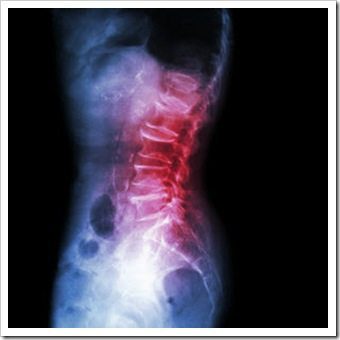
An X-ray will likely be ordered to be able to have a detailed look at the bones that make up the lumbar spine. Specifically, your chiropractic physician will look for new bone growth (osteophyte formation) and the narrowing of the intervertebral disc space. If a more detailed look is necessary, a CT (computed topography) or an MRI (magnetic resonance imaging)-may be ordered.
What Treatment Options Are Available?
Lumbar arthritis is usually responsive to conservative management.
During an acute attack of low back pain, relative rest that avoids activities that aggravate the symptoms may reduce inflammation. Drinking moderate amounts of water frequently while minimizing caffeinated drinks will also be beneficial in helping hydrate the discs.
For long term relief, lifestyle modification must be undertaken. This includes weight loss when appropriate as it will have a tremendous impact on reducing back pain due to the lumbar spine bearing the weight of the upper body and weight of the head.
Exercise is also critical as it will contribute to reducing weight while increasing muscle strength to support the lower back. You should consult your chiropractic physician before beginning any exercise or diet program.
Your chiropractor and their spinal rehabilitation team may prescribe spinal decompression in combination with rehabilitative therapy. Working the rehabilitative team to design a proper exercise regimen will be useful for strengthening core muscles and minimizing your back pain.
We Can Help!
Our team understands that long-term back pain is not only physically debilitating but emotionally exhausting. To serve our community, we have built an expert team committed to working together harmoniously to help you or your loved ones recapture the quality of life they desire – pain-free!
by Dr. Brandon Chorney | Apr 12, 2016 | Health Articles

Spring is here! Not officially, but we are getting revitalized and ready to go! With this added excitement it is time to begin the spring clean in our garden. Although we are invigorated by the warmth, gardening can provide a great workout but with all of the bending, twisting, reaching and pulling, your body may...
Read More >>
by Dr. Brandon Chorney | Apr 28, 2015 | Health Articles

April showers bring May flowers, but what can May flowers bring? That is right - possible back pain. As springtime gets under way, we head outside into the warm weather and begin the spring clean in our garden. We are invigorated by the warmth and begin tackling the garden in Gung-ho style. Although gardening can...
Read More >>
by Dr. Brandon Chorney | Apr 9, 2015 | Health Articles
A new report released on Tuesday, March 31st, 2015 is establishing that Acetaminophen- best known under the brand label of Tylenol- does not appear to help ease lower back pain and offers little relief for the most common form of arthritis. This review of data from thirteen studies could challenge existing recommendations on pain relief.
Acetaminophen Simple Household Pain Medication or More?
Acetaminophen, sold under the brand name Tylenol, among others, is now being considered as being labeled one of the most dangerous over the counter pain medications on the market. That’s alarming as almost every household has a bottle of this pain medication and doesn’t think twice about using it. The problem is that acetaminophen is considered relatively safe when taken as recommended, but the margin between a safe dose and potentially lethal one is extremely small. An FDA advisory panel actually recommended adding a warning label about liver damage to acetaminophen as early as 1977, but it was not done until 2009.
Acetaminophen overdose is actually the leading cause for calls to Poison Control Centers across the U.S., with upwards of 100,000 cases per year. This includes 56,000 emergency room visits, 2,600 hospitalizations and an estimated 458 deaths due to acute liver failure. Last year, PBS News reported that 1,500 deaths over the past 10 years have been linked to taking a little bit more acetaminophen than the recommended dosage.
Finally in early 2014, the FDA finally issued a statement urging doctors and other health professionals to discontinue prescribing and dispensing prescription combination drug products that contain more than 325 milligrams (mg) of acetaminophen per tablet, capsule, or other dosage unit. They go on to state that there is no evidence that by taking more there is any benefit that outweighs the risk of severe liver damage.
The Research
Researchers led by Gustavo Machado of The George Institute for Global Health at the University of Sydney in Australia performed and analyzed ten studies that examined the use of acetaminophen to treat osteoarthritis of the hip or knee, and three studies that assessed the use of the well know pain medication for lower back pain. Osteoarthritis sufferers who experience back pain where chosen as Osteoarthritis is the most common form of arthritis and this combination is one of the leading causes of disability worldwide. The other criteria was that current clinical guidelines recommend acetaminophen as the first-line drug treatment for both conditions.
As part of the study, researchers randomly gave 1,652 participants with acute lower back pain and 1,741 patients with osteoarthritis up to four weeks of acetaminophen in regular doses (three doses a day up to 3,990 mg a day), as-needed doses (up to 4,000 mg a day), or a placebo. Participants also received advice for managing their pain and reassurance, as well as follow-ups for three months.
What they found was surprising: For back pain sufferers, there was no difference in the number of days it took for study participants to recover from their pain, regardless of whether they took doses of acetaminophen or the placebo. On average, it took the groups that received acetaminophen 17 days to recover, and the group that took the placebo 16 days to recover. Acetaminophen also had no short-term effect on participants’ movement ability, sleep quality, or quality of life. Researchers also discovered that acetaminophen provided only minimal short-term relief for people with osteoarthritis.
Looking at the pooled data, the investigators found that for people with lower back pain, acetaminophen was ineffective in either reducing patient disability or enhancing quality of life. In people with osteoarthritis of the hip or knee, acetaminophen provided only a small, not clinically important benefit in the reduction of pain and disability.
According to a conclusion note made by the Australian study, acetaminophen, the active ingredient in Tylenol, is no more effective at relieving lower back pain and osteoarthritis than a placebo.
Additional Research Findings On Alternative Solutions:
General exercise, manipulation of the body, and core-specific exercises have also been shown to be effective treatments for back and osteoarthritis pain, says chiropractor Jay Greenstein, DC, vice chairman for the Council on Chiropractic Guidelines and Practice Parameters. Back pain, especially, should be treated by manipulation as “There’s usually a mechanical reason behind it. If you only choose to address it through chemical means, you’re not going to get long-term relief, and over time, your condition will become chronic.”
“Overall, there is mounting evidence that acetaminophen is not effective for relief of these conditions, while other forms of pain relievers, used judiciously, can be helpful, the emphasis in management of chronic pain related to degenerative joint diseases is increasing on non-pharmacologic measures” as state by Eric Matteson, MD, rheumatology chair at the Mayo Clinic in Rochester, MN.
Finally research studies have also found that acupuncture and yoga are also both effective ways to relieve both back and osteoarthritis pain. A 2014 joint study from the University of Minnesota and University of Maryland found that weekly yoga sessions improved osteoarthritis pain in older women and found that regular yoga classes and stretching improved back pain and function in sufferers of lower back pain. A 2012 study published in the Archives of Internal Medicine also found that participants had greater relief from back pain after receiving acupuncture compared to those who did not while they also discovered that acupuncture provided pain relief and improved function in people who have osteoarthritis in the knee.
Great Long Term Solutions
Whether you’re trying to address acute or chronic pain, please know that there are many other safer yet still effective alternatives to prescription and over-the-counter painkillers. What makes the body heals the body. By determining the cause of the pain, usually damage to the nervous system, and correcting that by chiropractic adjustments you won’t have to reach for this potentially lethal product.
by Dr. Brandon Chorney | Jun 17, 2014 | Health Articles

Nearly every adult today has experienced some form of back pain in their lifetime. Whether the pain was caused by lifting something awkwardly or from strenuous activity. More often than not this pain will subside after a period of rest, if it is purely muscular pain. However, spinal disc injuries cause more of an extreme...
Read More >>