by Dr. Brandon Chorney | Sep 11, 2012 | Health Articles

Few people understand the true importance of maintaining good posture. Despite our hearing about it on a pretty regular basis, why it matters and how to achieve it remain a little murky for many.
Why good posture matters
Good posture is more than standing up straight. You have posture when you stand, walk, sit, kneel, lie down, play sport, etc. Whatever position your body gets into, there is a right way and a wrong way of doing it. The right way reduces strain on the supporting muscles and ligaments. The wrong way hurts. Good posture does the following for you:
- Keeps your bones and joints correctly aligned so your muscles work correctly and your joints experience the least possible wear and tear, reducing the risk of degenerative arthritis and joint pain.
- Reduces the stress on the ligaments that hold your spinal joints together, making injury less likely.
- Allows your muscles to function with less effort, so you get less tired and stressed.
- Lowers the risk of muscle strain and overuse disorders that can cause back and muscular pain.
Common risk factors for bad posture include: obesity, stress, pregnancy, weak postural muscles, unusually tight muscles, high-heels, lack of flexibility, poor work ergonomics, and bad habits when sitting and standing.
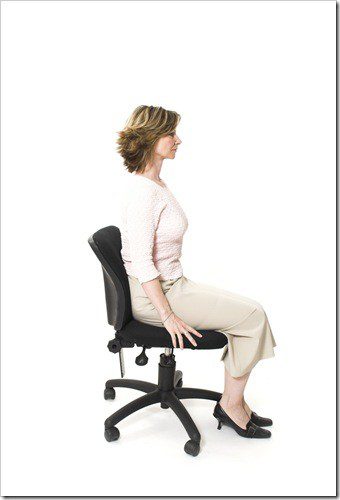
Sitting properly
- Your feet should rest on the floor. If they don’t, use a stool.
- Crossing your legs is not advised, and keep your ankles in front of your knees.
- Check there’s a small gap between the front of your seat and the back of your knees.
- Keep your knees at or below the level of your hips.
- Support your low- and mid-back, either with a backrest or back support.
- Don’t tense the shoulders, and check your forearms are horizontal.
- Get up and move about regularly when stuck sitting down for long periods.
Standing properly
- The balls of your feet should bear most of your weight.
- Don’t lock your knees; keep them slightly bent.
- Feet should be shoulder-width apart.
- Let your arms hang free at your sides.
- Stand straight and tall with shoulders pulled backward.
- Keep your stomach tucked in.
- Your head should be level, earlobes over your shoulders. Don’t force your head in any direction.
- When unavoidably on your feet for a while, shift your weight from your toes to your heels, or from one foot to the other, to share the burden.
Lying properly
- A suitable mattress is very important. Make sure you find one that is supportive and comfortable. This is a personal matter based on your own shape.
- Use a pillow to maintain your spine in proper alignment.
- Don’t sleep on your stomach.
- Sleeping on your side is less stressful on your spine than sleeping on your back.
- Place a pillow between your legs if you sleep on your side.
- Place a pillow under your knees if you sleep on your back.
Your doctor of chiropractic is there to help you achieve and maintain proper posture, and can help you to strengthen your core postural muscles with specific exercises. Sport-specific postural advice is also offered to help minimize the risk of injury.
by Dr. Brandon Chorney | Sep 6, 2012 | Health Articles
Temporomandibular Joint Disorder, also abbreviated to TMD or TMJ, is the name for a variety of conditions that affect the jaw joint. Symptoms vary from case to case, as does the severity of the symptoms. Most people who suffer pain in the jaw muscles or joints experience only temporary or cyclical problems. Other people go...
Read More >>
by Dr. Brandon Chorney | Sep 4, 2012 | Health Articles
While some fitness enthusiasts relentlessly seek out the latest, trendiest exercise crazes, many others are returning to good, old-fashioned walking to help them feel great and get into shape. Whether enjoying the wonder of nature, or simply the company of a friend, walking can be a healthy, invigorating experience. And thanks to its convenience and...
Read More >>
by Dr. Brandon Chorney | Aug 30, 2012 | Health Articles
As the fall gets under way, weather cools down and the leaves start to turn, many people will spend more time outside recovering bulbs, mowing the lawn, pulling weeds and raking leaves getting their garden ready for it's winter nap. Gardening can provide a great workout, but with all the bending, twisting, reaching and pulling,...
Read More >>
by Dr. Brandon Chorney | Aug 28, 2012 | Health Articles
Whiplash is one of the most common auto accident injuries, but there are many other ways in which this injury to the cervical spine can occur. When it does, studies show that Chiropractic care provides significant relief and long term healing results.
A whiplash injury occurs as the result of an abrupt backward and/or forward jerking movement of the head which causes an injury to the muscle, ligaments, tendons, and joints of the neck and back. This type of spinal injury most frequently occurs when a person is involved in an auto accident in which, the vehicle is struck in such a way as to cause the jerking motion of the head and neck to occur. However, this action can also occur while participating in a sporting event such as football, basketball or even baseball. It has also been known to occur while riding amusement park rides as well as the result of a significant fall.
What is actually injured with a whiplash injury?
Whiplash injuries most often result in sprain-strain of the neck. The ligaments that help support, protect, and restrict excessive movement of the vertebrae are torn, which is called a sprain. The joints in the back of the spine, called the facet joints, are covered by ligaments called facet capsules, which seem to be particularly susceptible to whiplash injury.
In addition, the muscles and tendons are strained—stretched beyond their normal limits. The discs between the vertebrae, which are essentially ligaments, can be torn, potentially causing a disc herniation. The nerve roots between the vertebrae may also be stretched and become inflamed. Even though it is very rare, vertebrae can be fractured and/or dislocated in a whiplash injury.
What does the research say about whiplash injuries?
The director of the Spine Research Institute of San Diego, Dr. Arthur Croft, says, “Nearly 1 out of 15 adult Americans suffers from the annoying and sometimes debilitating long-term effects of whiplash injury, usually in the form of neck stiffness and pain.” Fortunately, several studies regarding relief for whiplash injuries demonstrate Chiropractic’s effectiveness in offering a very high level of help. Here are the conclusions of four separate studies sited by the director of the Spine Research Institute:
- In a study published in Injury, 93% of 28 patients showed significant improvements following Chiropractic care. The protocol utilized to provide relief included spinal manipulation, stretching and ice therapy.
- A Study published in the Journal of Orthopedic Medicine concluded, “Whiplash injuries are common. Chiropractic is the only proven effective treatment in chronic cases.”
- Finally, two separate studies published in the Journal of Manipulative and Physiological Therapeutics confirm Chiropractic benefits. “For chronic spinal pain in general, when compared to traditional medical approaches, Chiropractic has generally been shown to be more effective.”
Practicing safe driving and using properly adjusted headrest restraints and seatbelts can go a long way to preventing whiplash accidents. Wearing the proper head gear in sporting activities, particularly for those playing a violent sport like football, can also help to prevent injury.
Ask your chiropractor what recommendations he or she can provide to keep your cervical spine in top condition and help you to avoid injury to the neck and back. Of course, should a whiplash injury occur, Chiropractic is the well established source of intervention and long-term relief.
by Dr. Brandon Chorney | Aug 23, 2012 | Health Articles
In today’s age of health and fitness, more and more kids are involved in sporting activities. Although being part of a football, soccer or Little League team is an important rite of passage for many children, parents and their children could be overlooking the importance of proper nutrition and body-conditioning needed for preventing injuries on...
Read More >>
by Dr. Brandon Chorney | Aug 21, 2012 | Health Articles
Years ago, doctors hardly ever told rheumatoid arthritis patients to "go take a hike" or "go for a swim." Arthritis was considered an inherent part of the aging process and a signal to a patient that it's time to slow down. But not so anymore. Recent research and clinical findings show that there is much...
Read More >>
by Dr. Brandon Chorney | Aug 16, 2012 | Health Articles
Even if you love fashion, you must know that it’s a pretty fickle beast. What’s in one day is passé the next. You spend hundreds on an item in March, and then wouldn’t be seen dead with it in May. But the worst of it is the toll it can take on you physically. No...
Read More >>
by Dr. Brandon Chorney | Aug 14, 2012 | Health Articles
If you have a headache, you’re not alone. Nine out of ten Americans suffer from headaches. Some are occasional, some frequent, some are dull and throbbing, and some cause debilitating pain and nausea. What do you do when you suffer from a pounding headache? Do you grit your teeth and carry on? Lie down? Pop...
Read More >>
by Dr. Brandon Chorney | Aug 9, 2012 | Health Articles
Chiropractic patients continue to report that they are more satisfied with their low back care than medical low back patients. Consider these recent low back pain findings: Satisfied with care: Chiropractic patients 96% Medical Patients 84% Treatment was helpful: Chiropractic patients 99% Medical Patients 80% Likely to seek care from another provider: Chiropractic patients 14%...
Read More >>